🎰 A 350 Pound Wrestler Grabbed Bruce Lee’s Collar on Live TV

It was 1967.
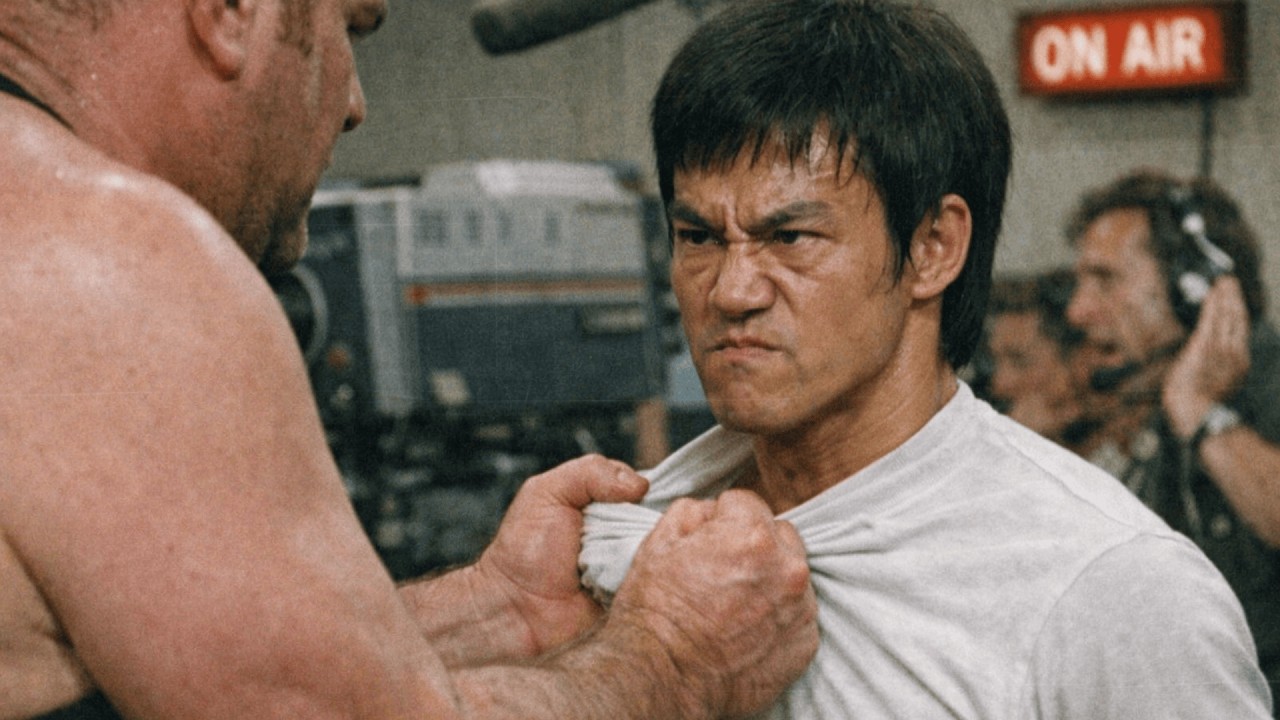
15 million Americans were watching a live television broadcast when a 350-lb professional wrestler named Big Boris Petrov grabbed Bruce Lee by the collar and lifted him off his feet.
The host froze.
The audience gasped and somewhere in the control room, a producer’s hand hovered over the kill switch.
What happened in the next 4 seconds would become the most controversial moment in talk show history.
So controversial that the network erased all footage and denied it ever happened.
Until now.
Bruce Lee didn’t want to do the show.
It was a Tuesday afternoon in Los Angeles and his manager had been pushing him for weeks.
The Milton Cole Show was one of the most popular talk shows on television.
15 million viewers every week.
An appearance could launch careers overnight.
“I don’t need publicity stunts,” Bruce said.
“I need serious students.”
“You have 20 students,” his manager replied.
“You could have 2,000.
You could have your own studio.
You could have everything you’ve been working toward.”
Bruce paced his small office in Chinatown.
The walls were covered with pH๏τographs.
Him training with students, demonstrating techniques, competing in tournaments.
Everything he had built, he had built himself.
No handouts, no shortcuts.
But his manager was right.
The school wasn’t growing fast enough.
His savings were running low.
His wife, Linda, was pregnant with their second child.
He needed money.
“Fine,” Bruce said finally.
“one appearance.
I demonstrate some techniques, answer some questions, and leave.”
“That’s perfect.
Milton will love you.”
“Who else is on the show?”
His manager hesitated.
“Who else?” Bruce repeated.
“They want to do a segment, you know, demonstrating martial arts against different fighting styles.”
“What fighting styles?”
“Wrestling.”
Bruce stopped pacing.
“They want me to face a wrestler on live television.”
“It’s just a demonstration, nothing serious.”
“Who’s the wrestler?”
His manager looked at the floor.
“Boris Petrov.”
Boris Petrov was not a normal wrestler.
He stood 6’5 in tall and weighed 350 lb.
All of it muscle, bone, and bad intentions.
He had been a Soviet weightlifting champion before defecting to America in 1962.
He had reinvented himself as a professional wrestler, playing the villain role to perfection.
His signature move was called the bear hug.
He would grab opponents around the chest, lift them off their feet, and squeeze until they surrendered.
In his entire career, no one had ever escaped the bear hug once it was locked in.
But Boris wasn’t just a performer.
Unlike most professional wrestlers who followed scripts and pulled their punches, Boris had a reputation for legitimately hurting people.
He had broken three opponents’ ribs in the past year alone.
He had ended careers.
He had sent men to hospitals.
The wrestling federation tolerated him because he drew crowds.
People paid to see Boris Petrov hurt people.
It was theater, but the pain was real.
Bruce had heard of him.
Everyone in the martial arts world had heard of him.
Boris had publicly mocked martial artists for years, calling them “dancing boys” who couldn’t handle a real fighter.
“Why him?” Bruce asked his manager.
“Why specifically, Boris?
“The producers thought it would be good television.
The contrast, you know, the small martial artist against the giant wrestler.”
“They’re setting me up to fail.”
“They’re setting you up to be seen by 15 million people.”
Bruce thought about Linda, about the baby coming, about the bills piling up on his desk.
“What does Boris think about this?”
“He agreed immediately.”
“I bet he did.”
Bruce looked at his hands, small, calloused from years of training.
He weighed 140 lb, soaking wet.
Boris outweighed him by over 200 lb.
On paper, it was no contest, but paper didn’t know Bruce Lee.
The Milton Cole Show taped at CBS Television City in Hollywood.
Bruce arrived 3 hours before airtime.
He wanted to see the stage, understand the space, know exactly what he was walking into.
The set was larger than he expected.
a raised platform with two chairs for interviews, a separate area for demonstrations, and an audience of 300 people arranged in curved rows.
Television cameras surrounded everything, ready to capture every angle.
Milton Cole himself came out to greet Bruce.
He was a short man with silver hair and a smile that never reached his eyes.
He had been hosting talk shows for 20 years.
He knew exactly how to manufacture drama.
“Mr. Lee, so glad you could join us.”
“Thank you for having me.”
“I have to tell you, the audience is very excited about tonight’s segment.
Very excited.”
“What exactly is the plan for the demonstration?”
Milton waved his hand vaguely.
“Nothing complicated.
You show some martial arts techniques.
We bring Boris out.
You demonstrate how martial arts works against wrestling.
5 minutes, maybe six.
Look, a pry.”
“Is it scripted?”
“Scripted?” Milton laughed.
“No, no, we wanted to be authentic, real, you know.”
Bruce didn’t like the sound of that.
“Has Boris arrived?”
“He’s in his dressing room.
You can meet him before the show if you want.”
“I’ll pᴀss.”
Milton’s smile flickered.
“As you wish.
We go live at 8:00.
Be ready by 7:45.”
He walked away, already talking to a producer about something else.
Bruce stood alone on the stage, looking at the empty seats that would soon be filled with people expecting entertainment.
He had a bad feeling about tonight, a very bad feeling, but it was too late to back out now.
By 7:30, the studio was packed.
300 people filled the audience seats, buzzing with anticipation.
They had heard about the special segment, The Martial Artist Versus the Wrestler.
Many of them were Boris Petrov fans who had come specifically to watch him crush another victim.
Bruce waited backstage, stretching, keeping his muscles warm.
He could hear the audience through the walls.
Laughter, chatter, the building energy of a crowd anticipating spectacle.
A production ᴀssistant approached him.
“Mr. Lee.
5 minutes.”
“Thank you.”
The ᴀssistant hesitated.
“Can I tell you something?”
“Go ahead.”
“Boris Petrov is not what he seems.”
Bruce looked at the young man.
He was barely 20 with nervous eyes and a clipboard clutched to his chest.
“What do you mean?”
“The demonstration isn’t going to be a demonstration.
Boris told the producers he wants to make it a real fight.
He wants to humiliate you on live television.”
“Did the producers agree to this?”
“They didn’t say no.”
The ᴀssistant looked around nervously.
“They think it’ll be good for ratings.
The small Asian guy getting crushed by the giant American wrestler.
That’s what they want to show.”
Bruce felt his jaw тιԍнтen.
“Thank you for telling me.”
“I’m sorry.
I just thought you should know.”
The ᴀssistant hurried away.
Bruce stood alone, processing what he had just heard.
This wasn’t going to be a demonstration.
It was going to be an ambush.
Boris Petrov was going to attack him for real on live television in front of 15 million people.
He had two choices.
He could walk away right now, refuse to go on, protect himself, go home safely, or he could go out there and show the world what martial arts could really do.
The production ᴀssistant’s voice came over the speakers.
“Mr. Lee to the stage.
2 minutes.”
Bruce took a deep breath.
He walked toward the light.
Milton Cole bounced onto the stage to thunderous applause.
“Good evening, everyone.
Welcome to the Milton Cole Show.”
The audience cheered.
The cameras rolled.
15 million Americans tuned in from living rooms across the country.
“Tonight, we have a very special treat for you,” Milton continued.
“We’re going to explore the ancient art of kung fu.
That mysterious fighting style from the Orient that’s been getting so much attention lately.”
He gestured toward the wings.
“Please welcome our first guest, martial arts instructor Bruce Lee.”
Bruce walked onto the stage.
The applause was polite but restrained.
Most of the audience didn’t know who he was.
He was just the opening act before the main event.
He sat down in the interview chair and Milton began asking questions.
“So, Mr. Lee, tell us about kung fu.
What exactly is it?”
Bruce explained.
He talked about philosophy, about discipline, about the harmony of mind and body.
He spoke eloquently and pᴀssionately, trying to convey decades of tradition in a few minutes of television.
The audience listened politely, but Bruce could tell they were waiting for something else.
“Now,” Milton said after 10 minutes, “I understand you’re going to give us a demonstration tonight.”
“That’s correct.”
“And you’ve agreed to demonstrate your techniques against a professional wrestler.”
“I have.”
Milton’s smile widened.
“Ladies and gentlemen, please welcome Big Boris Petrov.”
The audience erupted.
Boris Petrov walked onto the stage like a force of nature.
He was enormous, taller, wider, more imposing than he appeared in pH๏τographs.
His muscles bulged beneath a тιԍнт black t-shirt.
His eyes were cold and predatory.
He didn’t acknowledge Bruce.
He barely acknowledged Milton.
He just stood there, letting the audience absorb his presence.
“Boris,” Milton said cheerfully, “thank you for joining us.”
“I didn’t come to talk,” Boris said.
His voice was deep, heavily accented.
“I came to show what real fighting looks like.”
The audience cheered.
They wanted blood.
“Well, then, let’s get to it.”
Milton gestured toward the demonstration area, a padded section of the stage about 15 ft square.
“Mr. Lee, Mr. Petrov, if you’ll take your positions.”
Bruce stood and walked to the demonstration area.
He moved calmly, deliberately, showing no fear.
Boris followed, each footstep shaking the stage.
They faced each other.
The contrast was absurd.
Bruce in his simple black shirt, compact and lean.
Boris towering over him like a mountain.
“Now,” Milton said, “I understand we’re going to see how martial arts techniques work against wrestling.
Mr. Lee, would you like to explain what you’re going to demonstrate?”
Bruce opened his mouth to speak.
That’s when Boris grabbed him.
It happened so fast that most of the audience didn’t understand what they were seeing.
Boris’s mᴀssive hand sH๏τ out and grabbed Bruce’s collar.
His fingers, thick as sausages, bunched the fabric and yanked upward.
Bruce’s feet left the ground.
The audience gasped.
Milton Cole’s professional smile froze on his face.
“This is what I think of martial arts,” Boris growled, loud enough for the microphones to pick up.
“Dancing.
Nothing but dancing.”
He shook Bruce like a rag doll, the smaller man dangling from his grip.
In the control room, a producer’s hand moved toward the kill switch.
This wasn’t the plan.
This wasn’t supposed to happen like this.
if Boris hurt this man on live television…
But he hesitated, because what he saw on the monitor made him freeze.
Bruce Lee was smiling.
Time seemed to slow down.
Bruce hung from Boris’s grip, his feet 6 in off the ground.
350 lbs of hostile muscle holding him like a puppet.
But instead of panic, Bruce felt clarity.
Every sense sharpened.
Every nerve came alive.
He had trained for this moment his entire life.
In one fluid motion, Bruce’s hands came up—not to grab Boris’s arm.
That would be pointless.
Instead, his fingers found the precise pressure points on Boris’s wrist.
The nerve clusters that controlled his grip.
He pressed.
Boris’s fingers spasmed open involuntarily.
Bruce dropped to his feet.
Before the giant could react, Bruce was moving.
His front kick, the fastest in martial arts, sH๏τ upward and stopped one inch from Boris’s throat.
The audience went silent.
“If this were real,” Bruce said quietly.
“You would already be ᴅᴇᴀᴅ.”
Boris stared at him, frozen, the foot hovering at his windpipe.
He couldn’t believe what had just happened.
No one had ever escaped his grip.
No one had ever moved that fast.
He tried to grab Bruce again.
This time, Bruce didn’t let him get close.
What followed would be debated for decades.
Boris lunged at Bruce with a tackle, his signature move, the one that had crushed countless opponents.
His arms reached out to engulf the smaller man.
Bruce stepped sideways at the last possible instant.
Boris’s hands closed on empty air.
A palm strike hit Boris’s ear, not hard enough to rupture the eardrum, but hard enough to scramble his equilibrium.
The giant stumbled, suddenly dizzy.
Bruce moved behind him.
A sweep kick took Boris’s legs out from under him.
350 lbs of muscle crashed to the mat.
The audience was on their feet now, screaming, though no one could tell if they were cheering or panicking.
Boris rolled over and pushed himself up, his face twisted with rage.
He charged again, no technique, just raw power.
Bruce intercepted him with a front kick to the sternum.
Boris doubled over, the air driven from his lungs.
A spinning elbow connected with his jaw.
Boris Petrov, the man who had never been beaten, the man who had broken ribs and ended careers, went down like a felled tree.
The studio went silent.
In the control room, chaos erupted.
“Cut the feed.
Cut the feed.”
“We’re live.
We can’t just—”
“The sponsors will kill us.
Cut it now!”
The producer’s hand finally found the switch.
The live broadcast went to black, replaced by a test pattern and a message.
“We are experiencing technical difficulties.
Please stand by.”
15 million Americans stared at their televisions in confusion.
On the stage, Bruce stood over Boris’s prone body.
The giant was conscious, but dazed, unable to understand what had happened.
He had never been hit that hard.
He had never been moved that fast.
Milton Cole looked like he was about to have a heart attack.
His carefully planned segment had turned into something he couldn’t control.
“Mr. Lee,” he stammered.
“I think perhaps we should—”
Bruce walked to the edge of the demonstration area.
He wasn’t breathing hard.
He wasn’t sweating.
He looked exactly as he had before the fight started.
“I came here to demonstrate martial arts,” he said, his voice carrying across the silent studio.
“That’s what I did.”
He looked at Boris, who was slowly sitting up, holding his jaw.
“There’s no shame in losing to someone who’s trained harder than you.
The shame is in believing size and strength are enough.”
He walked off the stage.
The audience sat in stunned silence, unsure whether to applaud, to boo, or to simply process what they had witnessed.
4 seconds.
That’s how long the actual confrontation had lasted.
4 seconds to dismantle a 350-lb professional wrestler on live television, and the network had cut the feed before anyone could see the ending.
The phone calls started within minutes.
Sponsors were furious.
Network executives were panicked.
Lawyers were consulted about liability, about releases, about what exactly had been broadcast before the feed was cut.
By midnight, a decision had been made.
The footage would be destroyed.
All copies, the master tape, the backups, everything.
The network would issue a statement saying the segment had been cancelled due to technical difficulties.
Anyone who asked would be told that the confrontation never happened.
It was a cover up.
Clean, simple, effective.
Boris Petrov was paid $50,000 to keep his mouth shut.
He was told that if he ever spoke about what happened, his wrestling career would be over.
He agreed.
He had no desire to publicize his humiliation anyway.
Milton Cole was instructed to never mention the incident again.
He complied.
His career depended on the network’s goodwill.
But they couldn’t control everyone.
300 people had been in that audience.
They had seen everything.
And within days, they were telling anyone who would listen about the night they watched a 140 lb martial artist demolish a 350lb wrestler in 4 seconds flat.
The story spread through gyms, through dojos, through bars and barber shops.
It grew with each telling.
Some versions had the fight lasting 30 seconds.
Some had Bruce knocking Boris unconscious with a single punch.
The truth got buried under legend.
But the truth was remarkable enough.
Bruce Lee went home that night and said nothing to his wife.
He didn’t mention the ambush.
He didn’t mention the fight.
He didn’t mention the cover up that he knew was already underway.
He sat in his small office looking at the pH๏τographs on the walls, thinking about what had happened.
The network would bury the story.
The footage would disappear.
As far as official history was concerned, the fight never happened.
But Bruce knew something the network executives didn’t.
It didn’t matter.
The 300 people in that audience would talk.
their friends would talk.
The story would spread not through television but through word of mouth.
The old way.
The way that couldn’t be controlled.
And eventually the truth would find its audience.
His phone rang at midnight.
It was his manager.
“Bruce, I don’t know what to say.
The network is furious.
They’re threatening to sue.”
“Let them threaten.”
“But the footage… they’re destroying everything.”
“They can destroy the tape.
They can’t destroy what people saw.”
“What do you mean?”
Bruce looked at the pH๏τograph of himself training, young, determined, full of fire.
“I mean that 15 million people didn’t see what happened tonight, but 300 people did.
And by next week, 3,000 will have heard about it.
By next month, 30,000.
By next year, everyone who matters will know the truth.
The truth that a 140lb martial artist defeated a 350lb wrestler in 4 seconds.
That size and strength don’t matter against speed and skill.
That everything people believe about fighting is wrong.”
His manager was silent.
“They tried to humiliate me on live television,” Bruce continued.
“They set me up to fail.
Instead, I gave them the best advertisement martial arts has ever had.”
The footage was never recovered.
Despite decades of searching by collectors, historians, and fans, no copy of that night’s broadcast has ever surfaced.
The network kept its word.
Every master tape, every backup, every recording was destroyed.
But the story survived.
Boris Petrov never spoke about the incident publicly.
He retired from wrestling in 1972, citing injuries.
He died in 1989, taking whatever secrets he had to the grave.
Milton Cole denied the confrontation ever happened until the day he died.
In his autobiography, published in 1985, he wrote that Bruce Lee’s appearance on his show was unremarkable and quickly forgotten.
But the people who were there remembered.
One audience member, a college student named David Chen, wrote a detailed account of the incident in his diary that night.
That diary was discovered by his grandchildren in 2015 and published online, providing the first comprehensive written record of what actually happened.
“I will never forget what I saw,” Chen wrote.
“A man half the size of his opponent facing certain defeat and winning so completely that the network had to cut the feed to protect the loser’s dignity.
In 4 seconds, Bruce Lee proved that everything I thought I knew about fighting was wrong.”
The incident became one of many legends surrounding Bruce Lee’s stories that seemed too incredible to be true, that were dismissed by skeptics as exaggeration or myth.
But the people who knew Bruce, his students, his friends, his fellow martial artists, knew better.
They knew that the legends, if anything, understated what he was capable of.
A 350 lb wrestler grabbed Bruce Lee’s collar on live TV.
The producers cut the feed, but they couldn’t cut the truth.
Some stories are too powerful to be buried.
Some legends refuse to die, and some men are simply too extraordinary to be forgotten.
✓ admin
It was 1967. 15 million Americans were watching a live television broadcast when a 350-lb professional wrestler named Big Boris…